> ## Documentation Index
> Fetch the complete documentation index at: https://ai-development-environment.mintlify.site/llms.txt
> Use this file to discover all available pages before exploring further.
# Costs
> Model prices used to estimate what Plans and Sessions cost.
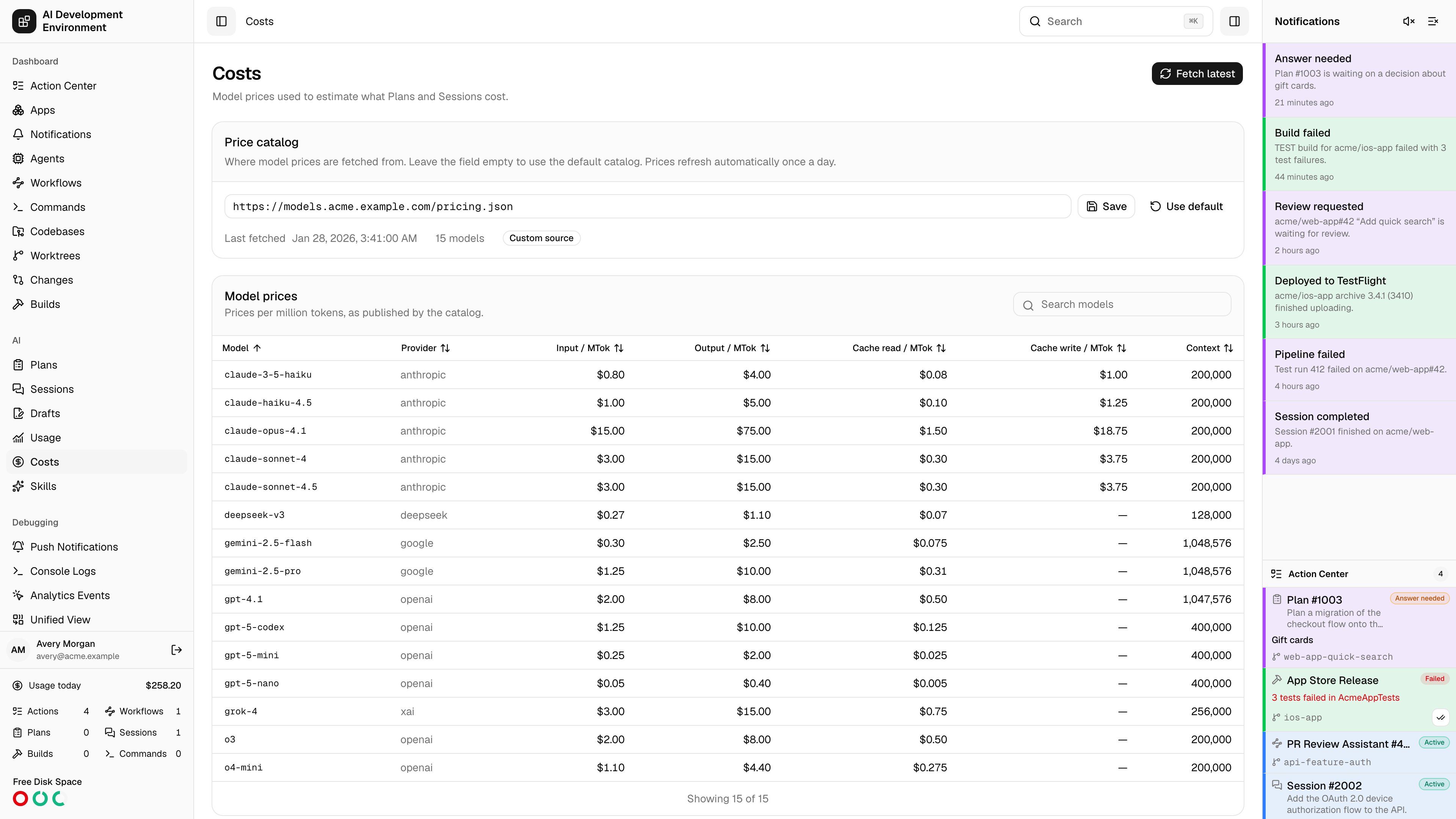
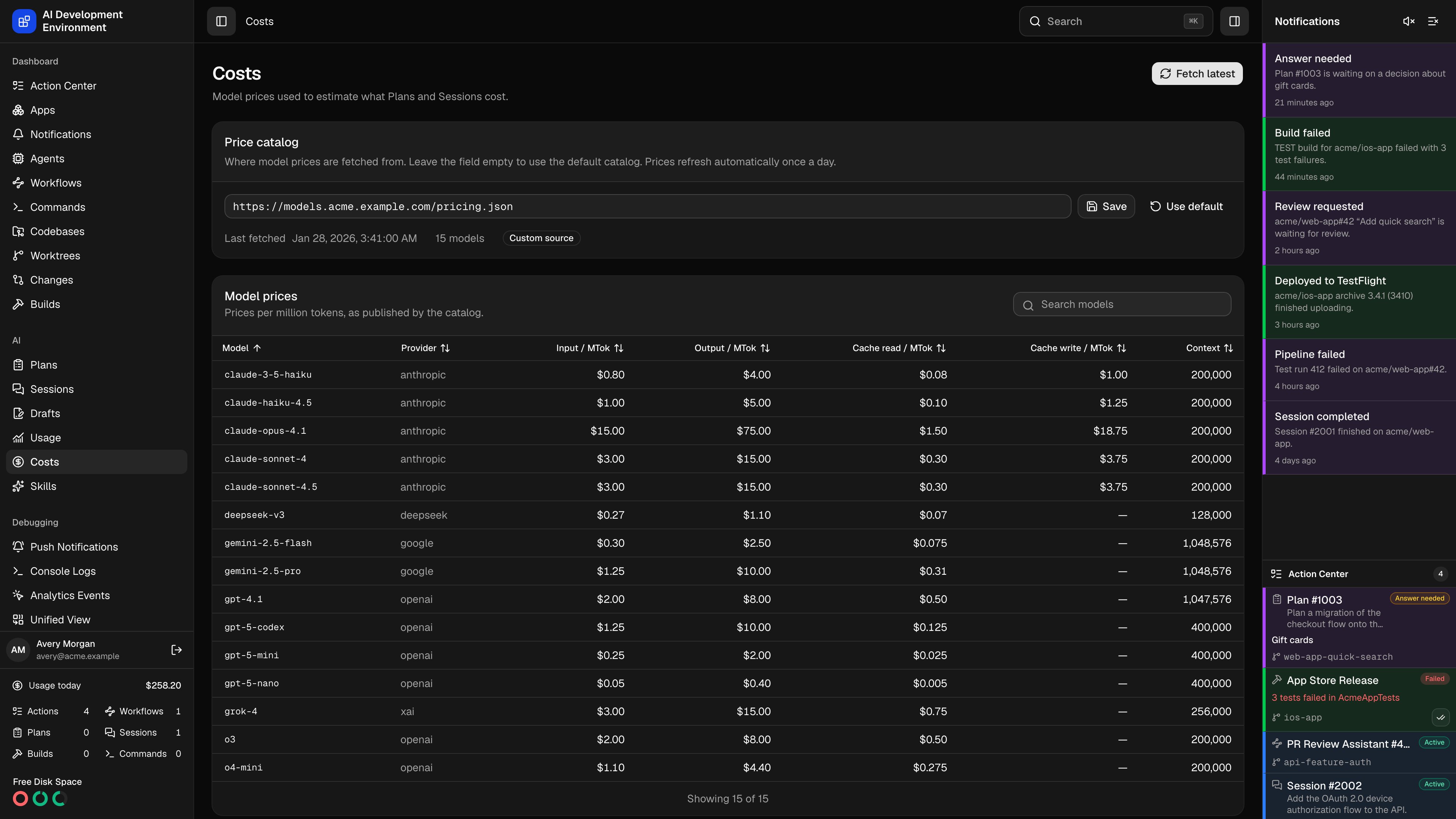 The **Costs** page at `/costs` manages the model price catalog. Every [Plan](/ai/plan-detail) and [Session](/ai/session-detail) reports a **Model cost catalog** figure alongside whatever the provider itself reported, and this catalog is where that figure comes from — one consistent set of prices applied to every run's token counts, regardless of which AI tool produced them.
Two cost numbers appear on a run for a reason. The provider's is what will show up on a bill. The catalog's prices every run the same way, so runs are comparable across tools — and the gap between the two is itself informative.
## The price catalog
The default source is LiteLLM's published `model_prices_and_context_window.json`, which is the one catalog covering every tool this app drives.
| Control | What it does |
| ------------------ | ----------------------------------------------------------------------------------- |
| **Model cost URL** | Point at your own catalog in the same JSON shape. Leave it empty to use the default |
| **Save** | Stores the URL and re-fetches from it |
| **Use default** | Clears the field, which is what restores the built-in source |
| **Fetch latest** | Refreshes now rather than waiting for the daily cycle |
Underneath, the card reports when prices were last fetched, how many models the catalog holds, and whether the source is the **Default source** or a **Custom source**. A **Refresh due** badge means the catalog is missing or more than a day old.
Prices refresh automatically once a day, and a page load that finds the catalog stale triggers a refresh on read. A fetch that fails is reported inline with the underlying error, and the previous prices stay in place rather than being cleared.
## Model prices
The table lists every priced model in the catalog. Prices are shown per million tokens, formatted to keep both cheap and expensive models readable — four decimal places under a dollar, two above it.
| Column | Contents |
| ---------------------- | ----------------------------------------- |
| **Model** | The catalog's model identifier |
| **Provider** | The provider the catalog attributes it to |
| **Input / MTok** | Price per million input tokens |
| **Output / MTok** | Price per million output tokens |
| **Cache read / MTok** | Price per million cached-read tokens |
| **Cache write / MTok** | Price per million cache-write tokens |
| **Context** | Maximum input tokens |
Every column sorts. Names open ascending; prices and context windows open descending, since someone sorting by those is usually looking for an extreme. Search filters the table server-side, and rows load 100 at a time as you scroll, with a **Showing *n* of *N*** count underneath.
A dash means the catalog publishes no value for that field — some entries price input and output but say nothing about caching.
## Notes
* A catalog entry with neither an input nor an output price is dropped rather than stored as a row that could never price anything.
* Changing the source URL re-prices future estimates only; figures already recorded on past runs are not rewritten.
* The catalog is shared across the whole control plane — it is not per agent, per repository, or per run.
## Related pages
Token spend collected from every enrolled machine.
Where the catalog cost appears alongside the provider's.
Estimated cost per run in the list.
Other control-plane-wide configuration.
The **Costs** page at `/costs` manages the model price catalog. Every [Plan](/ai/plan-detail) and [Session](/ai/session-detail) reports a **Model cost catalog** figure alongside whatever the provider itself reported, and this catalog is where that figure comes from — one consistent set of prices applied to every run's token counts, regardless of which AI tool produced them.
Two cost numbers appear on a run for a reason. The provider's is what will show up on a bill. The catalog's prices every run the same way, so runs are comparable across tools — and the gap between the two is itself informative.
## The price catalog
The default source is LiteLLM's published `model_prices_and_context_window.json`, which is the one catalog covering every tool this app drives.
| Control | What it does |
| ------------------ | ----------------------------------------------------------------------------------- |
| **Model cost URL** | Point at your own catalog in the same JSON shape. Leave it empty to use the default |
| **Save** | Stores the URL and re-fetches from it |
| **Use default** | Clears the field, which is what restores the built-in source |
| **Fetch latest** | Refreshes now rather than waiting for the daily cycle |
Underneath, the card reports when prices were last fetched, how many models the catalog holds, and whether the source is the **Default source** or a **Custom source**. A **Refresh due** badge means the catalog is missing or more than a day old.
Prices refresh automatically once a day, and a page load that finds the catalog stale triggers a refresh on read. A fetch that fails is reported inline with the underlying error, and the previous prices stay in place rather than being cleared.
## Model prices
The table lists every priced model in the catalog. Prices are shown per million tokens, formatted to keep both cheap and expensive models readable — four decimal places under a dollar, two above it.
| Column | Contents |
| ---------------------- | ----------------------------------------- |
| **Model** | The catalog's model identifier |
| **Provider** | The provider the catalog attributes it to |
| **Input / MTok** | Price per million input tokens |
| **Output / MTok** | Price per million output tokens |
| **Cache read / MTok** | Price per million cached-read tokens |
| **Cache write / MTok** | Price per million cache-write tokens |
| **Context** | Maximum input tokens |
Every column sorts. Names open ascending; prices and context windows open descending, since someone sorting by those is usually looking for an extreme. Search filters the table server-side, and rows load 100 at a time as you scroll, with a **Showing *n* of *N*** count underneath.
A dash means the catalog publishes no value for that field — some entries price input and output but say nothing about caching.
## Notes
* A catalog entry with neither an input nor an output price is dropped rather than stored as a row that could never price anything.
* Changing the source URL re-prices future estimates only; figures already recorded on past runs are not rewritten.
* The catalog is shared across the whole control plane — it is not per agent, per repository, or per run.
## Related pages
Token spend collected from every enrolled machine.
Where the catalog cost appears alongside the provider's.
Estimated cost per run in the list.
Other control-plane-wide configuration.