> ## Documentation Index
> Fetch the complete documentation index at: https://ai-development-environment.mintlify.site/llms.txt
> Use this file to discover all available pages before exploring further.
# Jira ticket details
> Edit a Jira ticket and review its activity, history, and fields.
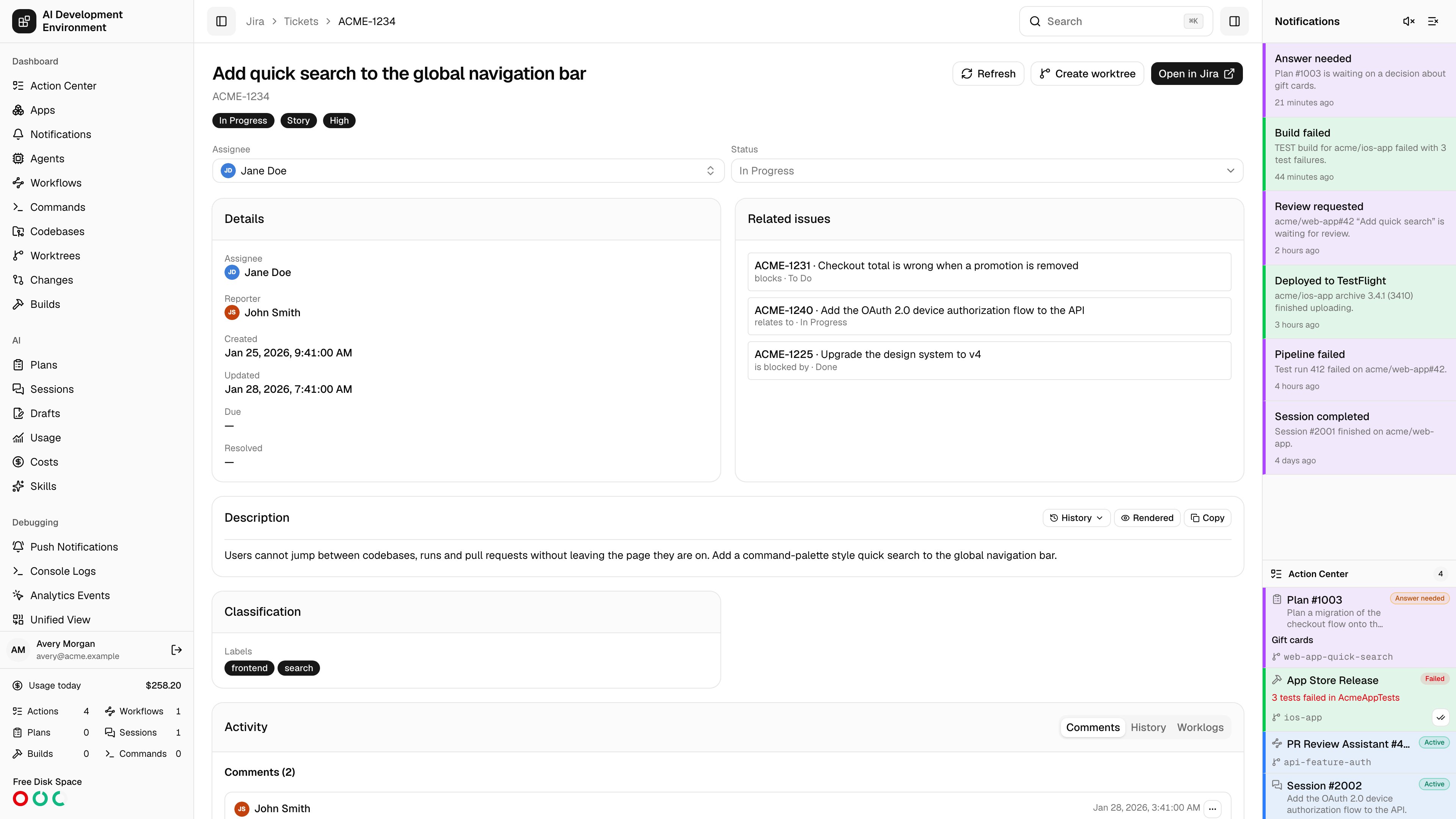
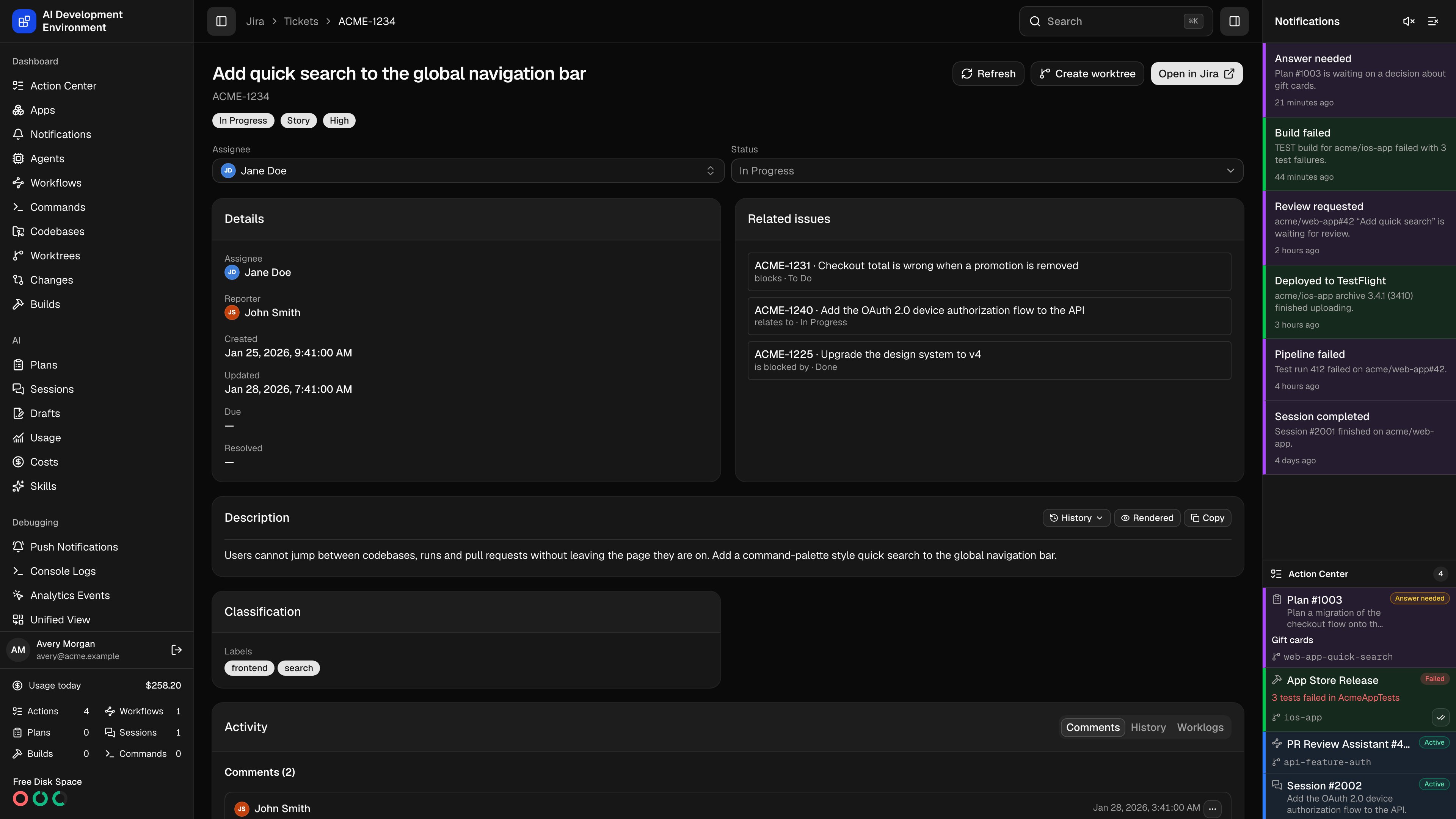 The Jira ticket details page at `/jira/tickets/{key}` is the full view of a single issue: summary, description, metadata, related issues, attachments, comments, change history, worklogs, and every raw field Jira returned. Everything editable here is written straight back to Jira.
It is the same ticket the drawer on [Jira Tickets](/jira/jira-tickets) shows, with the parts that need room — description history, activity tabs, and the complete field list.
## Header and actions
The summary is the page heading and is editable in place when Jira allows it. Below it are the issue key and badges for status, issue type, and priority.
| Action | What it does |
| ------------------- | ------------------------------------------------------------------ |
| **Refresh** | Re-reads the issue and its comments from Jira, bypassing the cache |
| **Create worktree** | Opens the same ticket worktree dialog as the tickets page |
| **Open in Jira** | Opens the issue in Jira in a new tab |
**Assignee** and **Status** sit directly under the header. The assignee picker searches Jira's assignable users for this issue as you type; the status picker lists the transitions Jira currently allows and applies the one you choose. A transition Jira requires a screen for is shown but disabled and labelled **Requires Jira**.
## Details and related issues
**Details** lists the assignee, reporter, and the created, updated, due, and resolved timestamps. **Edit** opens a dialog built from Jira's edit metadata for this issue, so it only ever offers fields your account can actually change on this issue type.
| Field | Input |
| --------------------------------------- | ---------------------------------------- |
| **Priority** | Jira's allowed priorities |
| **Labels** | Comma-separated values |
| **Components** | Checkboxes from the project's components |
| **Fix versions**, **Affected versions** | Checkboxes from the project's versions |
| **Due** | A date picker, clearable |
**Related issues** collects the parent, the subtasks, and every issue link in one list, each showing the relationship and the linked issue's status. Selecting one opens its own details page.
## Description
The description renders Jira's rich text — ADF, Jira Wiki markup, or Markdown — and can be viewed three ways.
| View | Shows |
| ------------ | --------------------------------- |
| **Rendered** | The formatted description |
| **Markdown** | The Markdown conversion, copyable |
| **Raw** | Exactly what Jira stored |
**Edit** opens a composer in the description's own authoring format, with **Markdown** and **Jira Wiki** as the two choices and a preview before saving.
### Description history
**History** beside the description compares two versions of the description text.
Opening it loads the ticket's change history from Jira. Every description value that ever appeared — the current one, plus the before and after of each change — becomes a version, labelled with its date and author.
**Compare from** and **Compare to** default to the previous version and the current one. **Load more** pulls older changes when the history is paged.
A line diff opens, additions in green and removals in red.
Jira only records description changes in the changelog, so a version exists only for edits Jira actually captured. Identical values are collapsed into one entry.
## Activity
**Activity** has three tabs. History and worklogs load the first time you open their tab, 50 entries at a time, with **Load more** for the rest.
| Tab | Contents |
| ------------ | ------------------------------------------------------------------------ |
| **Comments** | Every comment with its author and time, plus the composer for adding one |
| **History** | Jira's changelog — who changed which field, and from what to what |
| **Worklogs** | Logged time with author, duration, start time, and comment |
Comments are written in Markdown or Jira Wiki markup, with a preview, and can be copied in their raw form.
## All Jira fields
**All Jira fields** is the complete field set returned for the issue, collapsed by default. Expanding it gives a searchable table — filter by field name or field ID — where each row shows the field's display name, its ID, a **Custom** marker for custom fields, and its value.
Rich text fields render like the description. Scalar values are shown as text. Anything else is shown as formatted JSON.
This is the fastest way to find the ID of a custom field you want to reference in a workflow or a JQL query.
## Requirements
* Jira credentials in [Settings](/system/settings). Editing also needs a Jira account with permission to edit the issue.
* Creating a worktree from here needs the ticket's project to be managed on [Jira Tickets](/jira/jira-tickets) and an online agent with an available codebase.
## Notes
* Every edit, transition, assignment, and comment goes to Jira and then re-reads the issue live, so what you see afterwards is Jira's state, not a local guess.
* A ticket edit also drops that issue's cache entries, so other pages pick up the change on their next read.
* The page is served from the [Jira cache](/jira/jira-cache) on first load. **Refresh** forces a live read.
* With the [Jira webhook](/jira/webhooks) configured, the page updates itself when the issue changes in Jira — quietly, without a loading state.
* A banner appears when Jira could not be reached and expired cached data is being shown.
* Only fields Jira reports as editable are offered. A field missing from the edit dialog means Jira did not allow it for this issue, this issue type, or this account.
## Related pages
Projects, sources, boards, and the ticket queue.
The raw cached responses behind this ticket.
The Jira ticket details page at `/jira/tickets/{key}` is the full view of a single issue: summary, description, metadata, related issues, attachments, comments, change history, worklogs, and every raw field Jira returned. Everything editable here is written straight back to Jira.
It is the same ticket the drawer on [Jira Tickets](/jira/jira-tickets) shows, with the parts that need room — description history, activity tabs, and the complete field list.
## Header and actions
The summary is the page heading and is editable in place when Jira allows it. Below it are the issue key and badges for status, issue type, and priority.
| Action | What it does |
| ------------------- | ------------------------------------------------------------------ |
| **Refresh** | Re-reads the issue and its comments from Jira, bypassing the cache |
| **Create worktree** | Opens the same ticket worktree dialog as the tickets page |
| **Open in Jira** | Opens the issue in Jira in a new tab |
**Assignee** and **Status** sit directly under the header. The assignee picker searches Jira's assignable users for this issue as you type; the status picker lists the transitions Jira currently allows and applies the one you choose. A transition Jira requires a screen for is shown but disabled and labelled **Requires Jira**.
## Details and related issues
**Details** lists the assignee, reporter, and the created, updated, due, and resolved timestamps. **Edit** opens a dialog built from Jira's edit metadata for this issue, so it only ever offers fields your account can actually change on this issue type.
| Field | Input |
| --------------------------------------- | ---------------------------------------- |
| **Priority** | Jira's allowed priorities |
| **Labels** | Comma-separated values |
| **Components** | Checkboxes from the project's components |
| **Fix versions**, **Affected versions** | Checkboxes from the project's versions |
| **Due** | A date picker, clearable |
**Related issues** collects the parent, the subtasks, and every issue link in one list, each showing the relationship and the linked issue's status. Selecting one opens its own details page.
## Description
The description renders Jira's rich text — ADF, Jira Wiki markup, or Markdown — and can be viewed three ways.
| View | Shows |
| ------------ | --------------------------------- |
| **Rendered** | The formatted description |
| **Markdown** | The Markdown conversion, copyable |
| **Raw** | Exactly what Jira stored |
**Edit** opens a composer in the description's own authoring format, with **Markdown** and **Jira Wiki** as the two choices and a preview before saving.
### Description history
**History** beside the description compares two versions of the description text.
Opening it loads the ticket's change history from Jira. Every description value that ever appeared — the current one, plus the before and after of each change — becomes a version, labelled with its date and author.
**Compare from** and **Compare to** default to the previous version and the current one. **Load more** pulls older changes when the history is paged.
A line diff opens, additions in green and removals in red.
Jira only records description changes in the changelog, so a version exists only for edits Jira actually captured. Identical values are collapsed into one entry.
## Activity
**Activity** has three tabs. History and worklogs load the first time you open their tab, 50 entries at a time, with **Load more** for the rest.
| Tab | Contents |
| ------------ | ------------------------------------------------------------------------ |
| **Comments** | Every comment with its author and time, plus the composer for adding one |
| **History** | Jira's changelog — who changed which field, and from what to what |
| **Worklogs** | Logged time with author, duration, start time, and comment |
Comments are written in Markdown or Jira Wiki markup, with a preview, and can be copied in their raw form.
## All Jira fields
**All Jira fields** is the complete field set returned for the issue, collapsed by default. Expanding it gives a searchable table — filter by field name or field ID — where each row shows the field's display name, its ID, a **Custom** marker for custom fields, and its value.
Rich text fields render like the description. Scalar values are shown as text. Anything else is shown as formatted JSON.
This is the fastest way to find the ID of a custom field you want to reference in a workflow or a JQL query.
## Requirements
* Jira credentials in [Settings](/system/settings). Editing also needs a Jira account with permission to edit the issue.
* Creating a worktree from here needs the ticket's project to be managed on [Jira Tickets](/jira/jira-tickets) and an online agent with an available codebase.
## Notes
* Every edit, transition, assignment, and comment goes to Jira and then re-reads the issue live, so what you see afterwards is Jira's state, not a local guess.
* A ticket edit also drops that issue's cache entries, so other pages pick up the change on their next read.
* The page is served from the [Jira cache](/jira/jira-cache) on first load. **Refresh** forces a live read.
* With the [Jira webhook](/jira/webhooks) configured, the page updates itself when the issue changes in Jira — quietly, without a loading state.
* A banner appears when Jira could not be reached and expired cached data is being shown.
* Only fields Jira reports as editable are offered. A field missing from the edit dialog means Jira did not allow it for this issue, this issue type, or this account.
## Related pages
Projects, sources, boards, and the ticket queue.
The raw cached responses behind this ticket.