> ## Documentation Index
> Fetch the complete documentation index at: https://ai-development-environment.mintlify.site/llms.txt
> Use this file to discover all available pages before exploring further.
# Devices
> Enroll iPhones and iPads, review connection history, and register approved devices with Apple.
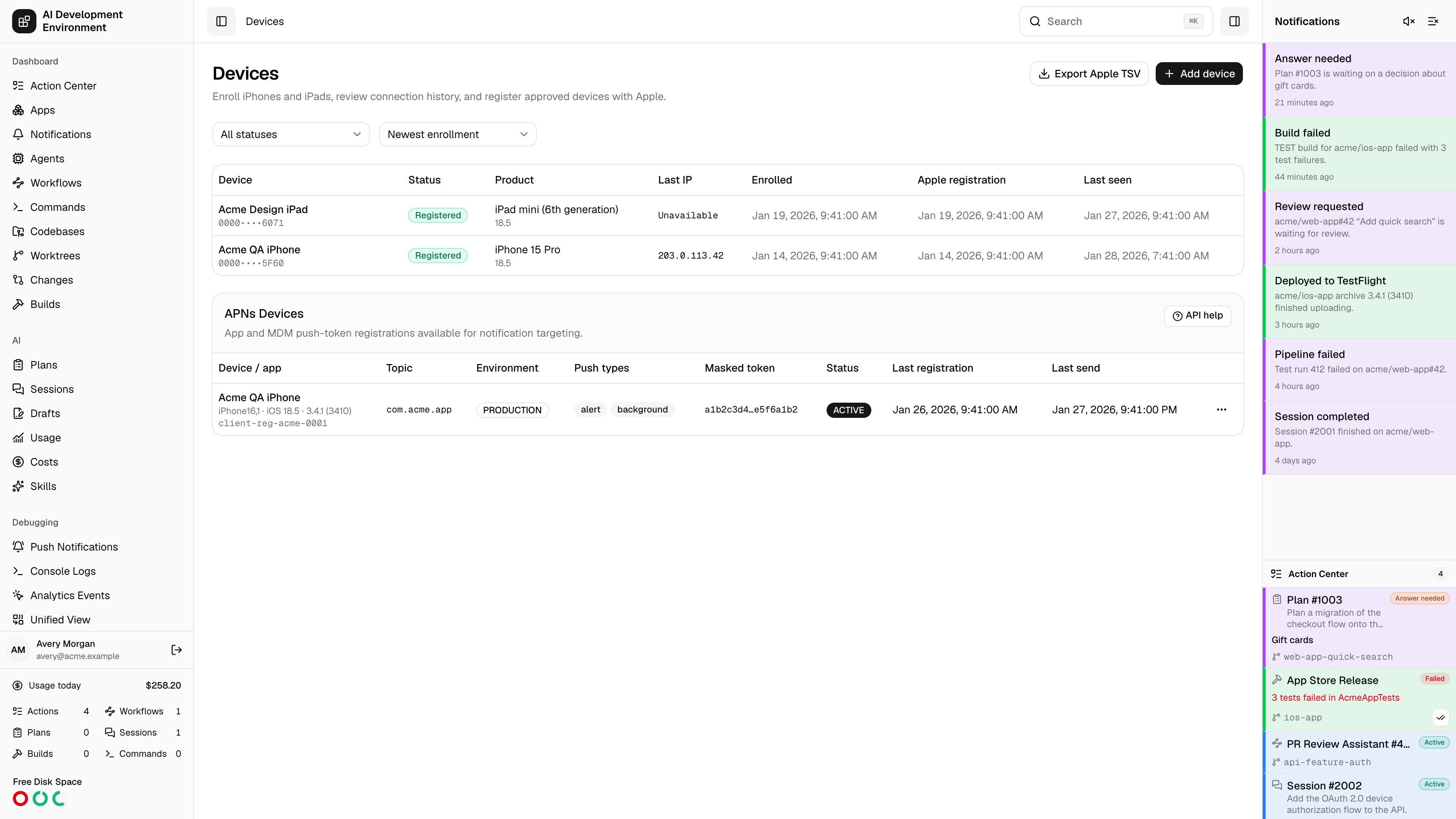
 The **Devices** page at `/devices` is the register of iPhones and iPads that are allowed to run your development builds. Getting a device onto that register normally means asking someone to find their UDID in Xcode or Finder and paste it into a chat — error-prone, and unpleasant to ask of a tester outside your team.
Instead, this page issues a one-time signed enrollment profile. The tester installs it, iOS returns the identifier directly to the server, and the device appears here with its product and iOS version already filled in. Registering it with Apple afterwards is a single button.
## Using the page
* **Add device** starts the [enrollment flow](/system/device-enroll) and produces a profile to install on the target iPhone or iPad.
* **Export Apple TSV** downloads every non-rejected device as a `Device ID / Device Name / Device Platform` file, the format Apple's bulk device upload expects.
* Filter by status and sort by newest enrollment, device name, or last seen.
* Select a row to open its [detail page](/system/device-detail), where registration, rejection, and deletion live.
| Column | What it shows |
| ---------------------- | ------------------------------------------------------------------------- |
| **Device** | The label given at enrollment |
| **Status** | Local lifecycle status (see below) |
| **Product** | The marketing name for the reported model, with the OS version beneath it |
| **Last IP** | The most recent address observed during enrollment |
| **Enrolled** | When enrollment completed |
| **Apple registration** | Whether and when the device was registered with Apple |
| **Last seen** | The most recent enrollment activity for this device |
iOS reports a hardware identifier (`iPhone16,2`) and a software build (`23F84`), not names a person would recognize. The list resolves both locally — `iPhone 15 Pro Max` over `26.5` — with no network call. A model Apple shipped after this build of the app is shown as its raw identifier, and a build number resolves to major and minor only, so `26.5.2` also reads as `26.5`. The [detail page](/system/device-detail) resolves the exact firmware version from IPSW\.me.
### Statuses
| Status | Meaning |
| ----------------------- | ----------------------------------------------------------------------------------------------- |
| **Pending** | Enrolled locally, not registered with Apple |
| **Registering** | An Apple registration call is in flight |
| **Registered** | Present in the Apple Developer account, with its resource ID stored |
| **Registration failed** | The Apple call failed; the reason is on the detail page and **Retry registration** is available |
| **Rejected** | Deliberately refused. It stays in local history and cannot be registered |
A registration stuck in **Registering** — because the server restarted mid-call, for example — is recovered automatically after five minutes and moved to **Registration failed** so you can retry it.
## Apple registration
Registering with Apple is optional. Enrollment alone gives you an accurate inventory and a UDID to hand to whoever manages the Developer account; registration automates that last step.
In App Store Connect, under **Users and Access → Integrations**, create a Team API key with **Certificates, Identifiers & Profiles** access. Copy the Issuer ID and Key ID, and download the `.p8` file — Apple offers it exactly once.
Enter the issuer ID, key ID, and ES256 PKCS#8 `.p8` key in [Settings](/system/settings). Saving verifies the credentials against `GET /v1/devices?limit=1` before storing them, so a bad key fails immediately rather than at the first registration.
On the device's detail page, **Register with Apple** first looks the UDID up in the account and reuses the existing resource if it is already there. Only a genuinely new device costs a create call against your annual device limit.
Registration does not regenerate a provisioning profile or rebuild an IPA. An app already installed on the device will not suddenly launch. After adding a device, create a new profile that includes it on [Provisioning Profiles](/system/provisioning-profiles), then export a new IPA from [Builds](/builds/builds).
## Notes
* Enrollment requires a publicly reachable HTTPS address, because Apple's profile service posts the device response to this server. See [Enroll device](/system/device-enroll) for the full flow.
* The enrollment profile requests only UDID, product, and iOS version, plus the IP address observed during the exchange.
* Deleting a device locally removes its record, enrollment attempts, and IP history. It does **not** remove the device from Apple's annual registration list — Apple only permits that during the yearly membership renewal window.
* Rejecting a device is the reversible option: it stays in history and can never be registered by accident. Delete and re-enroll if you change your mind.
## Related pages
The signed-profile flow that collects a device identifier.
Where a newly registered device has to be added before builds reach it.
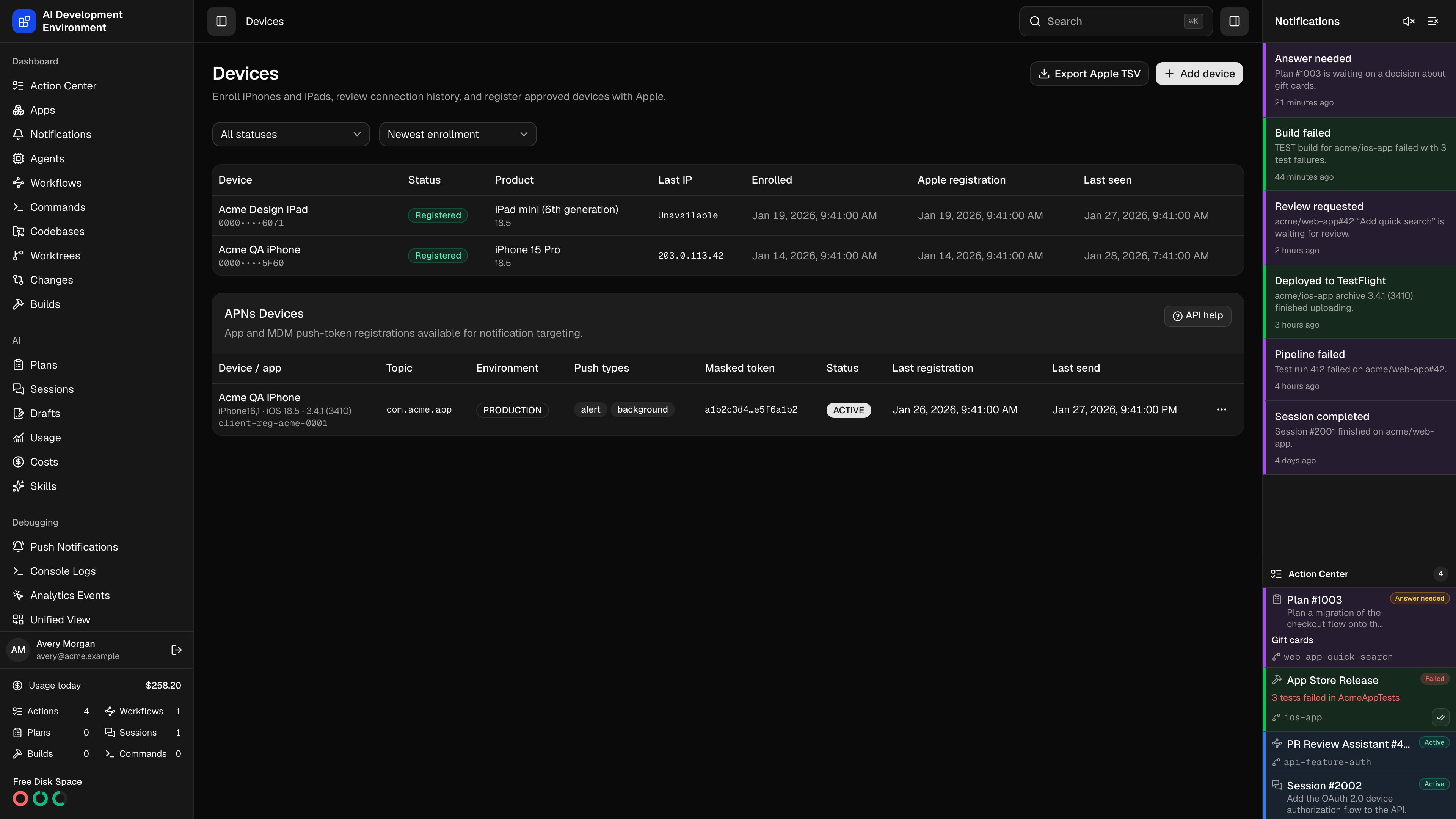
The **Devices** page at `/devices` is the register of iPhones and iPads that are allowed to run your development builds. Getting a device onto that register normally means asking someone to find their UDID in Xcode or Finder and paste it into a chat — error-prone, and unpleasant to ask of a tester outside your team.
Instead, this page issues a one-time signed enrollment profile. The tester installs it, iOS returns the identifier directly to the server, and the device appears here with its product and iOS version already filled in. Registering it with Apple afterwards is a single button.
## Using the page
* **Add device** starts the [enrollment flow](/system/device-enroll) and produces a profile to install on the target iPhone or iPad.
* **Export Apple TSV** downloads every non-rejected device as a `Device ID / Device Name / Device Platform` file, the format Apple's bulk device upload expects.
* Filter by status and sort by newest enrollment, device name, or last seen.
* Select a row to open its [detail page](/system/device-detail), where registration, rejection, and deletion live.
| Column | What it shows |
| ---------------------- | ------------------------------------------------------------------------- |
| **Device** | The label given at enrollment |
| **Status** | Local lifecycle status (see below) |
| **Product** | The marketing name for the reported model, with the OS version beneath it |
| **Last IP** | The most recent address observed during enrollment |
| **Enrolled** | When enrollment completed |
| **Apple registration** | Whether and when the device was registered with Apple |
| **Last seen** | The most recent enrollment activity for this device |
iOS reports a hardware identifier (`iPhone16,2`) and a software build (`23F84`), not names a person would recognize. The list resolves both locally — `iPhone 15 Pro Max` over `26.5` — with no network call. A model Apple shipped after this build of the app is shown as its raw identifier, and a build number resolves to major and minor only, so `26.5.2` also reads as `26.5`. The [detail page](/system/device-detail) resolves the exact firmware version from IPSW\.me.
### Statuses
| Status | Meaning |
| ----------------------- | ----------------------------------------------------------------------------------------------- |
| **Pending** | Enrolled locally, not registered with Apple |
| **Registering** | An Apple registration call is in flight |
| **Registered** | Present in the Apple Developer account, with its resource ID stored |
| **Registration failed** | The Apple call failed; the reason is on the detail page and **Retry registration** is available |
| **Rejected** | Deliberately refused. It stays in local history and cannot be registered |
A registration stuck in **Registering** — because the server restarted mid-call, for example — is recovered automatically after five minutes and moved to **Registration failed** so you can retry it.
## Apple registration
Registering with Apple is optional. Enrollment alone gives you an accurate inventory and a UDID to hand to whoever manages the Developer account; registration automates that last step.
In App Store Connect, under **Users and Access → Integrations**, create a Team API key with **Certificates, Identifiers & Profiles** access. Copy the Issuer ID and Key ID, and download the `.p8` file — Apple offers it exactly once.
Enter the issuer ID, key ID, and ES256 PKCS#8 `.p8` key in [Settings](/system/settings). Saving verifies the credentials against `GET /v1/devices?limit=1` before storing them, so a bad key fails immediately rather than at the first registration.
On the device's detail page, **Register with Apple** first looks the UDID up in the account and reuses the existing resource if it is already there. Only a genuinely new device costs a create call against your annual device limit.
Registration does not regenerate a provisioning profile or rebuild an IPA. An app already installed on the device will not suddenly launch. After adding a device, create a new profile that includes it on [Provisioning Profiles](/system/provisioning-profiles), then export a new IPA from [Builds](/builds/builds).
## Notes
* Enrollment requires a publicly reachable HTTPS address, because Apple's profile service posts the device response to this server. See [Enroll device](/system/device-enroll) for the full flow.
* The enrollment profile requests only UDID, product, and iOS version, plus the IP address observed during the exchange.
* Deleting a device locally removes its record, enrollment attempts, and IP history. It does **not** remove the device from Apple's annual registration list — Apple only permits that during the yearly membership renewal window.
* Rejecting a device is the reversible option: it stays in history and can never be registered by accident. Delete and re-enroll if you change your mind.
## Related pages
The signed-profile flow that collects a device identifier.
Where a newly registered device has to be added before builds reach it.