

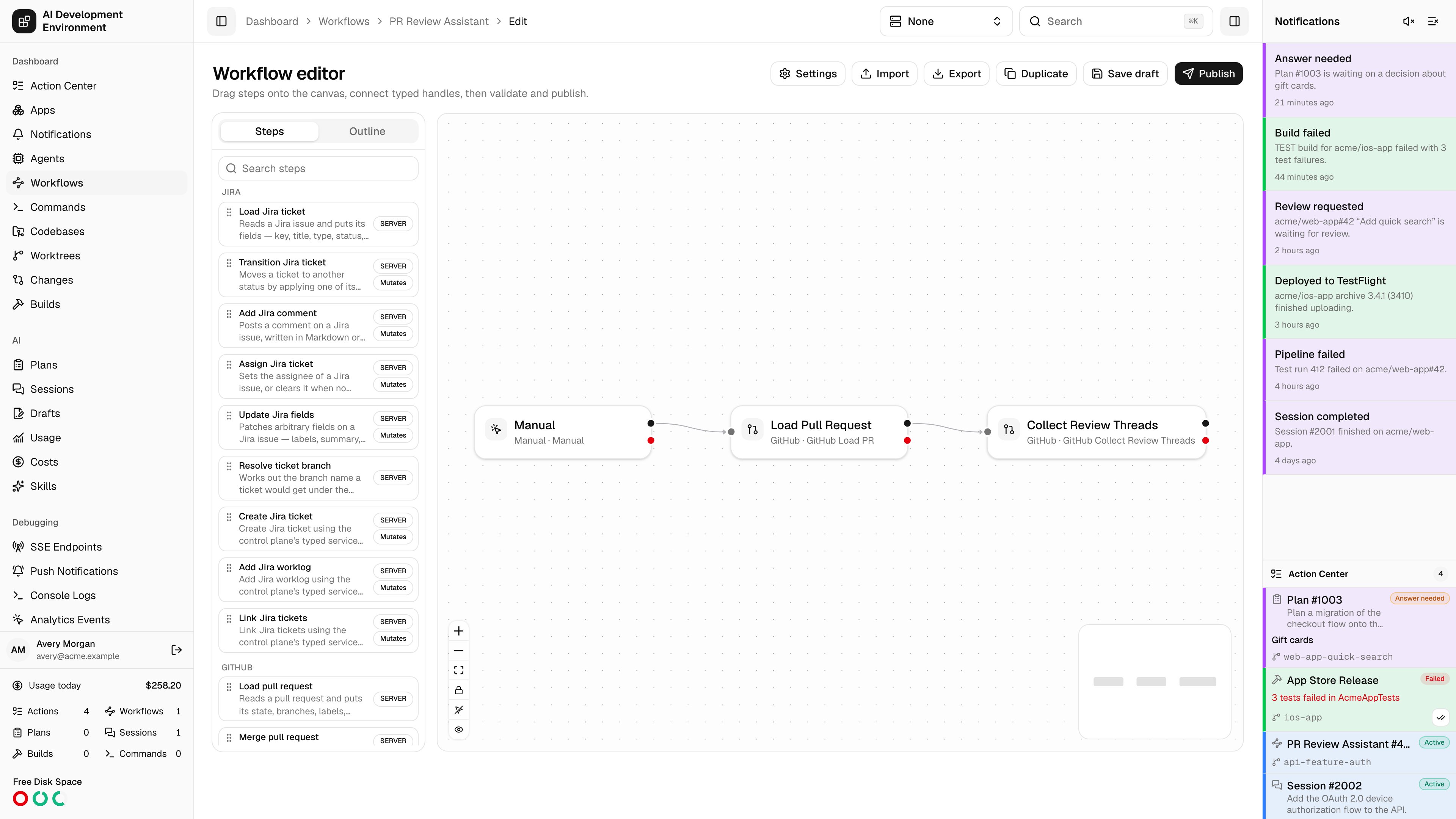
/dashboard/workflows/{id}/edit is a visual canvas for building durable automations. You place one trigger and a set of typed steps, connect their handles, configure each one, validate the graph, and publish an immutable version.
Anatomy of a workflow
Trigger
Exactly one, and it starts the run. Triggers cover manual starts, schedules, GitHub, GitLab, and Jira events, build results, worktree state changes, AI run lifecycle events, agent and disk thresholds, and more.
Steps
The work. Typed kinds span Jira, GitHub, GitLab, worktrees, codebases, builds, AI runs, skills, commands, notifications, signing, devices, control flow, and MCP calls.
Connections
Typed handles between nodes. Most steps expose
success and failure; control-flow steps name their own branches.Session data
A JSON document threaded through the run. Steps read values from it by path and write their results back into it.
Handles
The outgoing handles a node offers depend on its kind:An edge leaving a handle the node does not offer never becomes active, so the validator flags it rather than letting the run silently stall.
The canvas
The left panel toggles between the palette and the outline. The palette groups steps and triggers by category — Agents, AI runs, Builds, Codebases, Control flow, Extensibility, GitHub, GitHub Actions, GitLab, Human loop, Jira, Manual, Plans and sessions, Schedule, Skills, Workflows, and Worktrees — and searches across label, kind, category, and description. Drag an entry onto the canvas to add it. Canvas controls:
Right-clicking a node offers Duplicate step and Delete node; connections offer Delete connection.
Configuring a step
Selecting a node opens its inspector.Configuration
Configuration
Each step kind has a typed configuration schema rendered as a form. Fields without a form control are editable under Advanced (raw JSON), and the whole configuration can be pasted in at once with Configuration (JSON) → Apply configuration.Every value field can be switched between two sources with Switch value source:
- Use a fixed value — a literal you type now.
- Bind to session data — a session path such as
ticket.key, read when the run executes.
{token} interpolation to splice session data into a string at execution time.Session data contract
Session data contract
The inspector states what the step needs and what it produces:
- Additional required paths — session paths this step needs before it can run.
- Additional provided paths — paths it guarantees to write.
- Adds to session data / Seeds session data — the concrete keys it contributes.
Retries and failure
Retries and failure
- Maximum attempts — how many times the step may run.
- Retry strategy — Fixed delay or Exponential backoff.
- Retry delay — the base delay in seconds.
- Failure policy — Fail workflow stops the run; Continue routes out of the
failurehandle and keeps going.
Conditions
Conditions
An If step builds its condition from comparisons, matched with All of these are true or Any of these is true. Each comparison takes a session value, an operator, and a compared value.Operators: equals, does not equal, contains, does not contain, matches regex, does not match regex, is greater than, is at least, is less than, is at most, is set, is not set.Numbers and
true/false are compared as typed values; quote a value to compare it as text. The true handle runs when the condition matches, false otherwise. Conditions with nested groups the builder cannot draw fall back to JSON editing.Human choices
Human choices
A Human choice step defines the buttons shown while the run waits for an answer, each with a Button label and an optional Description.A choice trigger works the same way but at the entry point: each choice gets an Output key, becomes a menu item under the run button, and routes the run out of its own handle — so one workflow can offer several entry paths without a step in front of them. Output keys must be unique.
Model settings
Model settings
Steps that invoke a model expose Provider, Model, and Effort.
Reacting to command output
Saved command and Custom command steps can route work as soon as their output matches a case-sensitive RE2 regular expression. Set Output match pattern (RE2), keep Completion on Wait for exit, then connect thematch handle to an independent branch.
The match branch receives the current result at
steps.<stepId>.latestMatch; steps.<stepId>.matches keeps the ordered results emitted so far. Each result includes text, positional captures, namedCaptures, the command run and attempt, and start/end output coordinates. The command’s success or failure branch still activates when the process exits, so a match branch cannot reconnect to either terminal branch.
Matching works across output chunks and UTF-8 boundaries. Keep patterns focused: the matcher retains at most 16 MiB of unmatched output before it fails the step.
Importing coverage after a test command
For a non-Xcode test suite, connect these Builds and command steps in order:- Terminal run executes the tests and writes
coverage/lcov.infoor an Istanbulcoverage-final.jsoninside the worktree. - Import coverage report selects the worktree, the worktree-relative Coverage file, and AUTO, LCOV, or ISTANBUL format. The step waits for the agent and writes
build.idplusbuild.coverageSummary. - Read code coverage is optional. Add it when later steps need
build.coverageFilesandbuild.changedCoverageFiles, not just the totals.
Managing Tailscale Serve
The System category contains four typed fleet steps: Inspect Tailscale Serve, Upsert Tailscale Serve template, Set Tailscale Serve agent enabled, and Delete Tailscale Serve template. Agent fields are multi-selectors, template settings use typed catalog fields, and mutation steps wait for their durable operation before taking a handle. Results are written undertailscale.* and include the operation, per-agent progress, and a resource link to System → Tailscale. A partial fleet result takes failure; connect that handle to retry or recovery steps when partial availability is acceptable. See Tailscale Serve automation interfaces for MCP equivalents.
Workflow settings
Workflow settings is grouped into three sections, and each field explains itself underneath.Overlap scope
The overlap policy decides what happens when a trigger fires while a run is in flight. Overlap scope decides which runs it is measured against.
The default is Per worktree, which is what you want for a workflow that is triggered per branch — ten worktrees can each run it at once without lining up behind each other. Choose Every worktree when the workflow touches something shared, such as a release or a deployment, and only one pass should be under way at a time.
Scope applies to Keep latest pending event as well: a trigger only replaces a pending run that is inside the same scope.
Worktree concurrency and Git blocking
Worktree concurrency applies when a top-level run resolves a worktree. It is separate from overlap, which only compares this workflow’s own runs.
Non-exclusive is the default. An older exported workflow that reserved its worktree imports as Exclusive; other older workflows import as Non-exclusive.
Enable Block Git operations during command and terminal steps when those steps can modify repository or worktree state. Dedicated Git and worktree steps always serialize. Exclusive workflows enable Git blocking automatically. Plans and Sessions started by an exclusive workflow can still run inside its admission reservation.
Worktree admission for AI run steps
Create plan and wait, Run AI session and wait, Run completed plan, and Follow up run expose a Worktree concurrency limit.- Plans and Sessions use separate FIFO lanes on each worktree.
- Plans default to unlimited concurrency. Sessions default to one active run.
- Enter
1through32for a finite same-kind limit, or0for unlimited concurrency. - A queued run at the front of a lane is not bypassed by a newer run with a looser limit.
Turning off completion notifications suppresses successful-run notifications only. Failure and attention notifications still fire. MCP clients can use
completionNotificationsEnabled, overlapScope, worktreeConcurrency, and blocksGitOperations on create_workflow or update_workflow_settings.Validate, save, publish
Validate
Runs the full checker and lists Validation diagnostics against the offending nodes and edges.
Save draft
Persists your work in progress. The draft has no effect on running behavior.
Publish
Creates a new immutable version and makes it the one that runs. Save before publishing — the editor will tell you if you have not.
Common diagnostics
Related pages
New workflow
The same editor, opened on a blank canvas.
Workflow details
Published version, quick actions, and version history.